
Perspectives: Tarnia Elsworth on Building a Business with Inclusion at its Core
Authored by Dr Beth Charlton
To celebrate the launch of our LGBTQ+ Women of Impact 2025 list, we’ve been in conversation with some of the trailblazing women making huge strides in raising the visibility and representation of LGBTQ+ women in their organisations. Over the next few weeks, we’ll be spotlighting different Women of Impact as part of our new editorial series. Spotlighting the personal experiences and achievements of individual women, we’ll be unpacking themes of visibility, representation, role-models, safe spaces, contemporary challenges and barriers to inclusion for LGBTQ+ women in the workplace.
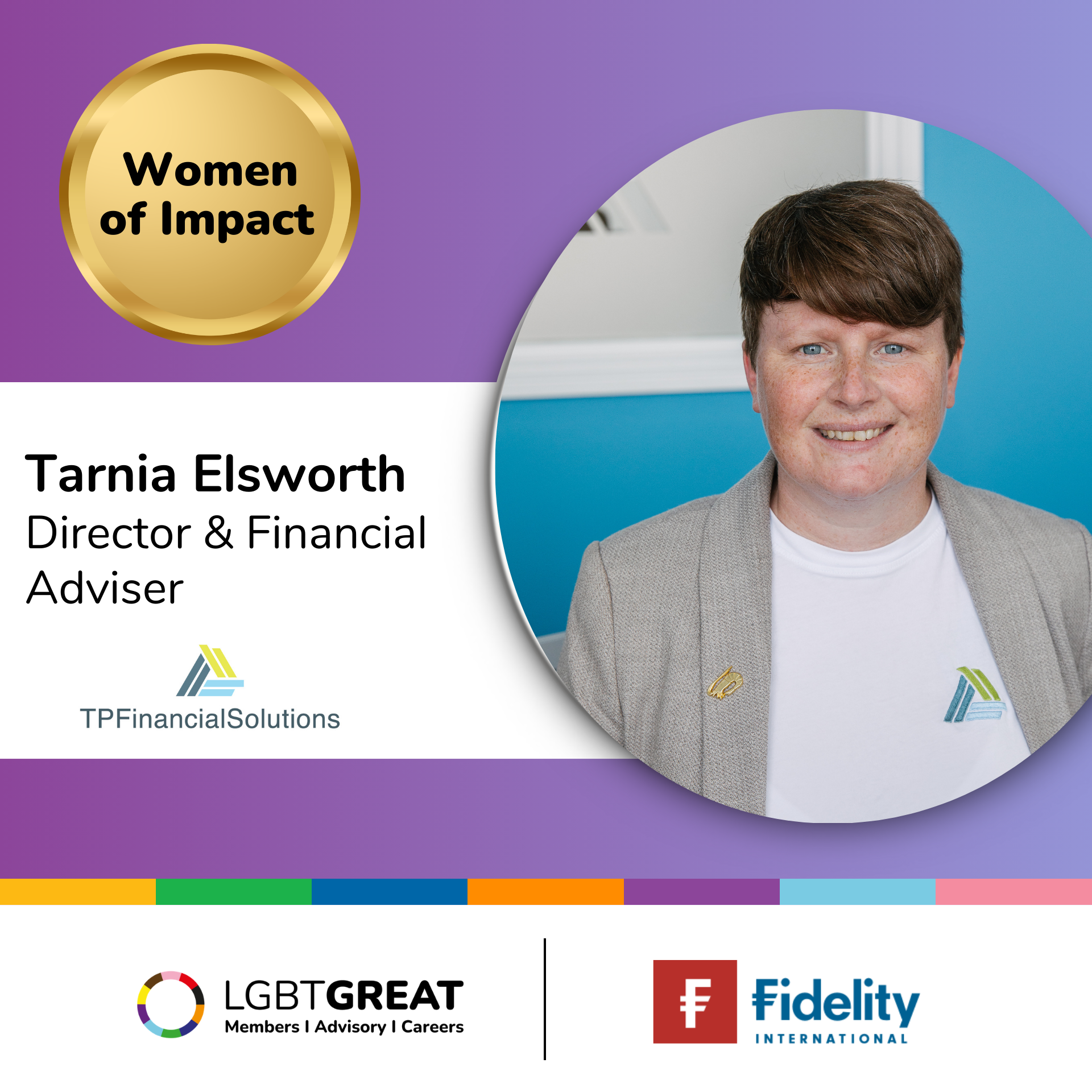
For the final iteration of the Women of Impact editorial series, I spoke to Tarnia Elsworth, Director and Financial Adviser at TP Financial Solutions. Working alongside her wife, Annabel, who holds the same roles, Tarnia has built a business that focuses on inclusive financial advice in an approachable and community focussed manner. Exploring her career journey, we discussed her experiences of being an LGBTQ+ woman in a male-dominated industry, inclusive businesses, and the benefits of diverse representation.
Ruminating on how her identity as a gay woman had impacted her workplace experience throughout her career, Tarnia explained how sexism and misogyny had played a role in how she has been treated by other colleagues at work. Facing sexist remarks and treatment in male-dominated spheres, Tarnia explained that she felt as though she had faced more discrimination throughout her career due to her gender than her sexuality.
I think I’ve felt more discriminated [against] for being a woman. It's always hard to identify why somebody's being a bit different with you compared to somebody else. And when I've reflected on that over time, I genuinely think it's because of I'm a woman rather than because I'm a gay woman. In the workplace, especially male dominated careers, which I'm in – financial advice and football, you can't get more male dominated than that. Really, genuinely, I think the difference is she's a woman and she doesn't know what she's talking about. Or she's, not meant to be in these spaces.
So no in the workplace I don't think I have [been discriminated against] for being gay. It's more a gender thing that I've had, you know, ‘oh whose secretary, are you?’ and ‘put the brew on love’ and all that. I genuinely don't think it's because of my sexuality, I think it's [because of] my gender.
Tarnia was not alone in drawing this conclusion; As the Women of Impact insights paper will highlight, the majority of Women of Impact participant responses raised gender bias and inequality as the most pressing and prominent barrier to inclusion at work for LGBTQ+ women, with sexism and misogyny cited most often as being the root cause of the discrimination they faced in the workplace. After all, the power structures and systems that shape our societies, are of course reflected and re-inscribed in our places of work. As Tarnia gestured towards, this is perhaps particularly apparent in industries, careers and workplaces that have been traditionally male dominated. With the UK awarded its lowest ranking in 2025 for workplace gender equality in a decade, and dropping to its lowest ever position in the ILGA-Europe rainbow map, gender inequality continues to impact the workplace experience of women[SD1] ; Tarnia noted that in the current climate, this was more evident than ever, stating that ‘I think we are living in a society where everything is moving slightly, right. And the two [Conservatism and misogyny] go hand in hand, don't they?’
Being the change, she wanted to see in the industry, Tarnia – in partnership with her wife Annabel – set about building a business that would pose a challenge to the way in which financial services are commonly viewed and experienced. Reflecting on her career journey, Tarnia explained that going self-employed and establishing a business with inclusive principles at its core was a defining moment in her career, where her experience as an LGBTQ+ woman in financial services began to improve.
Going self-employed really helped, because I think it enabled us to run our business how we would want to run our business. I think it helped us to do things with our values at the core. I don't think that's necessarily about being gay, it's just about being inclusive. And it's about saying, right, we work in the financial services industry, yes, historically this has been for wealthy men, but that’s not us. This is who we are. And the thing that has encouraged us to keep going is the positive feedback we then get from people who use our services. They say ‘I have looked at two websites for financial services, one was very traditional [corporate, no diversity], and then yours was you and your family on the beach and you looked like the kind of people we wanted to work with.’ So, I think it's that positive reinforcement of people saying ‘we're really glad that you're putting yourself out there’. So, whether that's for being a woman, whether that was for being a gay woman or whatever it is, ‘we're just glad that you're putting yourself out there. And I identify myself in you’, which is nice.
Tarnia’s words clearly underscore that building a business that prioritised inclusivity was not only beneficial for her own experience, but also of the experiences of her clients and the people who use her services. LGBT Great’s 2023 research Seeing is Believing underlined that seeing visible role models reflected in businesses impacts how customers and clients perceive the attractiveness of engaging/transacting with an organisation, with 59% of respondents agreeing that they were more likely to shop with or purchase from an organisation that has visible LGBTQ+ role models. Embedding diversity and inclusion within workplaces and organisations doesn’t just benefit the employees who work there, but it also has the potential to attract a diverse customer base and impact business outcomes.
Tarnia went on to talk further about the business case for building an organisation and workplace where inclusion and diversity are prioritised and evident. Speaking of her socio-economic background, and how this has set her apart from the majority of those around her throughout her career, Tarnia emphasised that fostering a diverse workforce is imperative for businesses that want to succeed in the long run; with diverse identities, comes diversity of thought, more perspectives and lived experiences, and ultimately a happier and more ‘robust business’.
I would say that my biggest difference in my industry is that I came from a low socio-economic background and now I work in wealth and in spaces [where] there's nobody like me in those spaces from that perspective. So, I think when you are different in an industry or in a space, you see things differently. But I always say and, I'll die on this hill, that that is positive for any business. That you don't just go ‘right, I'm this person, I look how a person should look who runs a business, therefore I know how best to run it.’ That's absolute nonsense. You know, if you want a successful, diverse, longevity business, you need to get the perspectives of different people with different eyes and different views…[You need to] listen to people who look, sound and have different experiences to you, because I think that's where workplaces are going wrong. You know, if there's a board, if there's a staff advisory group, make sure that everybody brings a difference to that table. It's only going to lead to happy workplace culture and a robust business considering different perspectives.
Contemplating what she felt most proud of in her career so far, Tarnia’s response further re-iterated the impact that building a business on inclusive principles has had both on her personally, and the clients that see themselves and their values reflected in her business.
I think I'm most proud of when people say they've chosen to work with us because we're the difference they want to see in the industry. When we get reviews or when somebody says to me ‘we've specifically chosen to work with you and Annabel because of who you are as people. And because of what your values are’, I think it really gives us that reassurance that setting up on our own, doing it slightly differently, was the right thing to do.
By challenging the status quo, Tarnia has made a meaningful difference in diversifying an industry in which she initially felt like she didn’t belong. Founding and running a successful LGBTQ+-woman-owned business in a sector that has been traditionally perceived as male, Tarnia’s inspirational career journey exemplifies why leading with inclusive values is both impactful and an imperative. Striving to increase the – much-needed – visibility of LGBTQ+ women, our Women of Impact programme continues Tarnia’s admirable work of being the difference people want to see in the industry.