
Perspectives: Marion Bentata on the Importance of Building Safe Spaces and Community for LGBTQ+ Women in Banking and Finance
 Authored by Dr Beth Charlton
To celebrate the launch of our LGBTQ+ Women of Impact 2025 list, we’ve been in conversation with some of the trailblazing women making huge strides in raising the visibility and representation of LGBTQ+ women in their organisations. Over the next few weeks, we’ll be spotlighting different Women of Impact as part of our new editorial series. Spotlighting the personal experiences and achievements of individual women, we’ll be unpacking themes of visibility, representation, role-models, safe spaces, contemporary challenges and barriers to inclusion for LGBTQ+ women in the workplace.
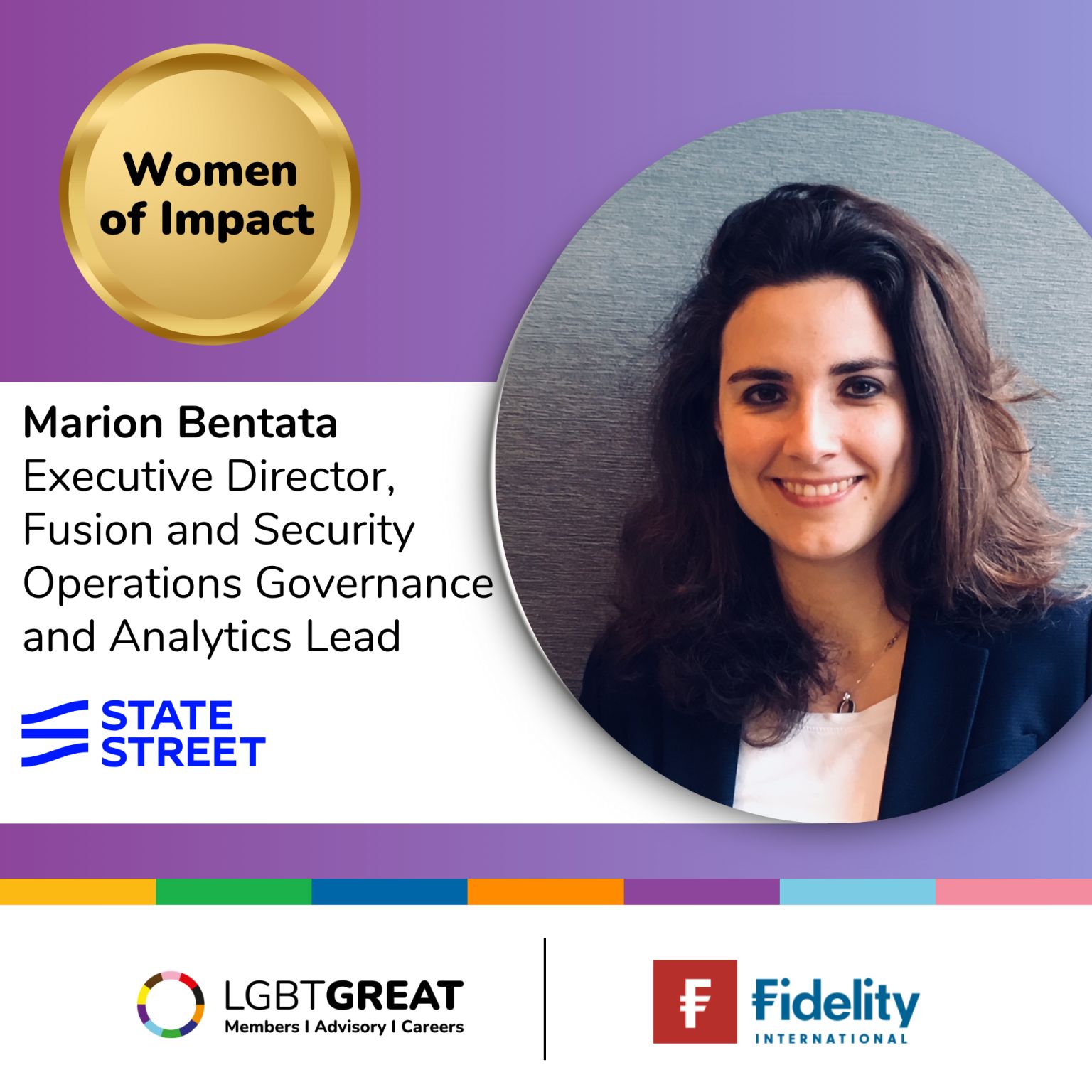
For the third instalment, I talked to Marion Bentata, Executive Director at State Street, who has been championing, advocating for, and raising the visibility of LGBTQ+ women in her organisation and the financial services sector. Founder of Women of InterBank, an industry network providing LGBTQ+ women with dedicated events and networking opportunities, Marion’s leadership has carved out much needed space and visibility for LGBTQ+ women in the industry. Talking ERGs, lack of representation and visibility, Marion stressed the necessity of building safe spaces for LGBTQ+ women and the power of networks.
Our conversation began with me asking Marion to reflect on the environment she found herself in during her early career. Recalling her move from France to London in the late 2000s, Marion pointed to the surprise she felt when finding herself in a workplace that was much more progressive than she was used to. Delighted to find that people were starting to come out at work, with established LGBTQ+ networks and community networking events providing opportunity for the LGBTQ+ employees of her organisation to connect, she explained that there was nevertheless one noticeable drawback: an absence of LGBTQ+ women.
So, it was all wonderful, but there remained a tiny little problem – at all of the LGBTQ+ events I used to go to, I was very often the only woman in the room. And as time progressed, I started joining various networks, and again on most of the committees I used to sit on, I would be one of the rare women around the table. And this was an issue we could see across the board because regardless of the company and almost across all sectors, pride networks were largely dominated by cis white men, and women – if and where they were present – were often the outliers in the room.
A 2008 study on the experiences of lesbian workers in the UK draws similar conclusions to those outlined here by Marion. Surveying 150 LGB employees across 15 organisations, the study found that workplace LGBT networks were commonly dominated by white men, positing that the higher participation of more senior employees caused such networks to reflect the ‘gendered and racialised division of labour’. Whilst this study, along with Marion’s recollections above, regard the experiences of women in the mid to late 2000s, the gender imbalance that they both underscore nevertheless persists today. Marion spoke to the wider impact that this has on LGBTQ+ women beyond ERGs and pride networks, noting that in an industry where a large proportion of senior roles continue to be filled by white men, it is unsurprising that LGBTQ+ women consequently choose to conceal their sexual identities in an attempt to limit the barriers to inclusion they come up against.
As women working in this still heavily heteronormative and white male dominated environment, it is far more likely that we will suppress a part of our identity if we don't see people who look like us around us. Now, you can't really hide the fact that you're a woman, right? So, guess which part of your identity you are going to sacrifice on the altar of conformity in order to blend in and feel like you belong?
So yes, things have started to improve, but sadly, many women are still experiencing misogyny and unconscious gender discrimination. Study after study also shows that a vast majority of women are still trying to come to terms with a number of self-imposed barriers, such as imposter syndrome, self-doubt and a lack of confidence. So, you can't really be surprised at the end of the day if women don't feel comfortable coming out on top of that, potentially adding an element of sexualization and objectification to their already difficult workplace experience.
For Marion, the misogyny and unconscious bias that continue to impact the experiences of LGBTQ+ women in financial services must be challenged by senior leaders through education, mentorship programmes and providing spaces in which LGBTQ+ women feel ‘supported, valued and celebrated’.
Urging senior leaders to ‘make it your mandate to create this safe space’ for LGBTQ+ women, Marion’s own experience of creating a space and platform for LGBTQ+ women in financial services speaks to the significant impact that this can have. Through the establishing of Women of InterBank in 2019, Marion has created a trailblazing forum for LGBTQ+ women, offering the opportunity for connection and community building amongst queer women in banking and finance. Reflecting on her career achievements, Marion’s words emphasise just how vital this safe space has been, working to instil feelings of belonging and offering the support that LGBTQ+ women may not find in their places of work.
What I am probably the most proud of is to have created a safe space and a sense of community for queer women in banking in London. For me, creating a safe space is a central concept to this story, because queer women in this day and age are still struggling with a number of issues, as we alluded to earlier. Be it historically negative stereotypes, the lack of role models and the fact that most of us don't really want to be known as the only lesbian in our organisation. And through the power of networks that we thankfully have here in London, we have managed to build a critical mass of women that was needed to create a snowball effect, which in turn has given birth to this community where people now feel like they belong. And honestly, there is nothing more touching than when a woman sends you a message saying “you know, I've been really struggling at work…and I've really felt supported by the Women of InterBank Group”.
Providing LGBTQ+ women with the opportunity to connect, network and take up space in which they are the majority has clear impact, enabling women to feel the support, representation and belonging that is perhaps absent in their places of work.
Alongside carving out a safe space for LGBTQ+ women, Marion has also worked to ensure that LGBTQ+ women are better represented, with their concerns and voices taken into account, in the pride ERGs and networks that she’s been involved with. Since taking over as Co-Chair of InterBank, the network of LGBTQ+ networks for financial services firms in the UK, Marion’s leadership has seen the representation of LGBTQ+ women grow inordinately.
As I described earlier, when I initially joined the network, there were two women on the committee and very few women in the room at the events organised by the network. And so it took us a while, but I think through all of the work that I did as head of inclusion of the InterBank subgroup we managed to turn things around. For example, a third of our committee members now identify as female or non-binary. We have a WhatsApp group through which we have managed to build a strong community of queer women. And now at the events that we organise, there are no longer just one woman in the room, but instead it's much more gender balanced, which is something that we are quite proud of at InterBank.
Thanks to Marion’s exemplary efforts, the InterBank Network is now more diverse in terms of gender than ever. This example goes to show that when LGBTQ+ women see themselves represented, prioritised and celebrated in a network, organisation or space, they are more willing to show up, take part and be counted. Sharing in Marion’s vision and commitment, LGBT Great’s Women of Impact programme extends this essential work, elevating the voices and experiences of LGBTQ+ women, raising the visibility of remarkable role models, and offering organisations with pragmatic measures they can take to address the contemporary challenges faced by LGBTQ+ women in the workplace.