
Perspectives: Marie-Helene Tyack on Increasing the Visibility of LGBTQ+ Women
Authored by Beth Charlton
To celebrate the launch of our LGBTQ+ Women of Impact 2025 list, we’ve been in conversation with some of the trailblazing women making huge strides in raising the visibility and representation of LGBTQ+ women in their organisations. Over the next few weeks, we’ll be spotlighting different Women of Impact as part of our new editorial series. Spotlighting the personal experiences and achievements of individual women, we’ll be unpacking themes of visibility, representation, role-models, safe spaces, contemporary challenges and barriers to inclusion for LGBTQ+ women in the workplace.
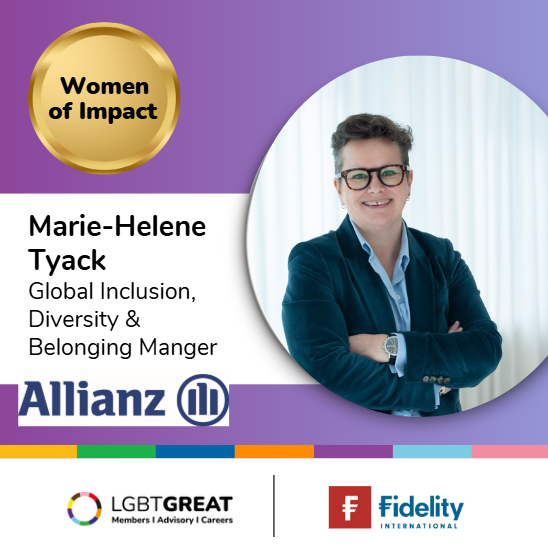
For our first instalment, I interviewed Marie-Helene Tyack, an out lesbian leader driving systemic change in Diversity, Inclusion and Belonging at Allianz Commercial and beyond. As Global Inclusion, Diversity and Belonging Manager, Marie-Helene has spearheaded global inclusive policies on transitioning at work, menopause, fertility and domestic abuse, whilst also overseeing 30+ LGBTQ+ ERGs worldwide in her role as Chair of the Global Allianz Pride Board. Exploring her personal experiences and career journey, we talked all things lesbian visibility, the impact of role models and the importance of being true to yourself.
The (in)visibility of LGBTQ+ women in the workplace was an important theme that punctuated Marie-Helene’s interview, and indeed her career journey. In the opening question, I asked Marie-Helene to reflect on the environment for LGBTQ+ women that she found herself in when starting her career. She explained that when she entered the workforce in the late ‘90s/early 2000s, the representation of LGBTQ+ women was noticeably lacking in the organisation she joined.
I would say [LGBTQ+ women were] non-existent… I remember telling a couple of my colleagues [that I was gay] and they reacted a little bit weirdly. And I thought, well, I was working in recruitment at the time, and I thought, oh, I'm not going to push this. And of course there was nobody at all who was out. There were no kind of visibly queer women in the organisation that I worked with. So absolutely non-existent. Thankfully, things have evolved, and it's not great [now], but things have certainly evolved.
For Marie-Helene, the negative reactions of the colleagues she came out to in her first organisation, coupled with the absence of visible role models, impacted her willingness to be out and open about her sexuality during the early stages of her career. Following an incident when, unbeknownst to her, she was outed prior to joining a new organisation, Marie-Helene made the decision to never hide her identity at work again. Reflecting on how the environment for LGBTQ+ women in the workplace had changed since this time, she explained that whilst things had certainly improved for the LGBTQ+ community in general, the limited visibility of LGBTQ+ women was a problem that nevertheless persisted, remaining a key barrier to inclusion for LGBTQ+ women in the corporate world today.
So, like obviously, the lack of representation – I mean, it's kind of like a catch-22 – but the lack of representation is certainly one of the main factors I think is that there is, well, still very few out women in the corporate space. I think for women as well, there is this feeling of having a double glass ceiling because still there is sexism in the workplace. Whether we'd like to admit it or not. But you know, and this explains also perhaps why there aren't so many women that want to come out because they think, ‘OK, well, I've got this glass ceiling above my head anyway because I'm a woman. Why am I going to voluntarily add another glass ceiling by being out?’ So, I think those two things are quite important.
And if you think too, about the intersectional piece because as a woman, you might have other kind of intersectional aspects to your identity, you could have a disability and you could be a woman of colour. All these things. And I don't think we think about that enough in in terms of barriers and how this could impact our career progression that we have these intersectional pieces that also add to the double glass ceiling.
Professor of business Julie Gedro has referred to the dual discrimination that LGBTQ+ women face in the workplace as the ‘double bind’, underscoring how the dual identity of being LGBTQ+ and being a woman can lead to increased experiences of discrimination; this is further exacerbated by factors such as race, disability, age and social class. As Marie-Helene pointed out, in order to minimise the dual impact of misogyny and homophobia, some LGBTQ+ women decide not to come out at work, ultimately contributing to the invisibility of LGBTQ+ women in organisational settings and perpetuating the problems that they face. Gedro has argued that this consequently creates a lack of LGBTQ+ women role models, yet their presence could ‘be a critical factor in untangling lesbians from this bind’. As Marie-Helene explained, this problem is a ‘catch-22’.
Whilst Marie-Helene spoke of the negative impacts that a lack of visibility causes, she also gestured to the, perhaps more unexpected, positive impact it has had on her career.
I think the lack of visibility has impacted me because it's made me do what I do today, and it's made me want to be visible. It's made me want to be a role model. It's made me want to do all these things…I was at a panel, it was it was for Lesbian Visibility Week this year in New York, and I heard somebody say that just – and I'm going to forget this because I've got perimenopausal brain – but the quote was something along the lines of ‘just showing up as yourself is a political act’. And that really resonated with me because I do lots of activism in my spare time, and I know the workplace isn't necessarily the place for that, but it kind of really is, and especially today.
For Marie-Helene, an absence of visible role models, and an overarching lack of representation, has motivated her throughout her career, making her ‘want to do more’ for her community and other LGBTQ+ women. Talking about the impact that visibility can have, her words indicate why such work is so vital, helping to improve the feelings of belonging felt amongst LGBTQ+ women in the workplace.
If somebody who's joining the organisation. Can see me and say, ‘oh my goodness, look, here's an out queer woman. Then maybe I can be out.’ [Visible representation] is important. It is important because it's about, I think there are three layers. One is like the sensation of belonging. So, if you're joining an organisation and you see that there are other queer women within your organisation, you feel that you're, that you belong, which is one thing. But then if you see that there are visible queer women in positions of leadership. Then you think ‘OK, well, my identity is being considered as well because this person can get to whatever level they are in their career.’ I don't want to stay in spite of, but because of their identity. So that's being considered in who they are and what their career looks like so maybe that this could apply to me as well.
Working to improve the visibility of queer women and other LGBTQ+ folks, by driving Diversity, Inclusion and Belonging initiatives at both Allianz Global and Allianz Commercial, Marie- Helene has been recognised for her efforts, receiving multiple awards, including the ‘Inspirational Role Model’ Rainbow Honours award in 2023. During our interview, Marie-Helene spoke of the impact that this recognition had on her.
I've won a couple of awards, and the first one I won was in 2023, I think, and it was for a role model and for me it was like, wow, this is just the weirdest thing. Because to have an award based on your work or something is something tangible. But to get an award for being an inspirational role model, I was like, this is just crazy. I just couldn't get my head around it, but also that kind of shifted something in my mind as well…But it was like I've never had that person I've never had, you know…a role model or an out queer woman role model, and that if I can be that for somebody else, then that's amazing.
Striving to provide the representation that she didn’t see at the beginning of her career and becoming the visible role model for younger queer women that she never had, Marie-Helene’s work, efforts and determination to be authentically herself, fully embody the old adage ‘you can’t be what you can’t see’.