
Perspectives: Claire Skinner Kennedy on Creating Inclusive Workplaces Where LGBTQ+ Women are Represented and Feel Like They Belong
 Authored by Dr Beth Charlton
To celebrate the launch of our LGBTQ+ Women of Impact 2025 list, we’ve been in conversation with some of the trailblazing women making huge strides in raising the visibility and representation of LGBTQ+ women in their organisations. Over the next few weeks, we’ll be spotlighting different Women of Impact as part of our new editorial series. Spotlighting the personal experiences and achievements of individual women, we’ll be unpacking themes of visibility, representation, role-models, safe spaces, contemporary challenges and barriers to inclusion for LGBTQ+ women in the workplace.
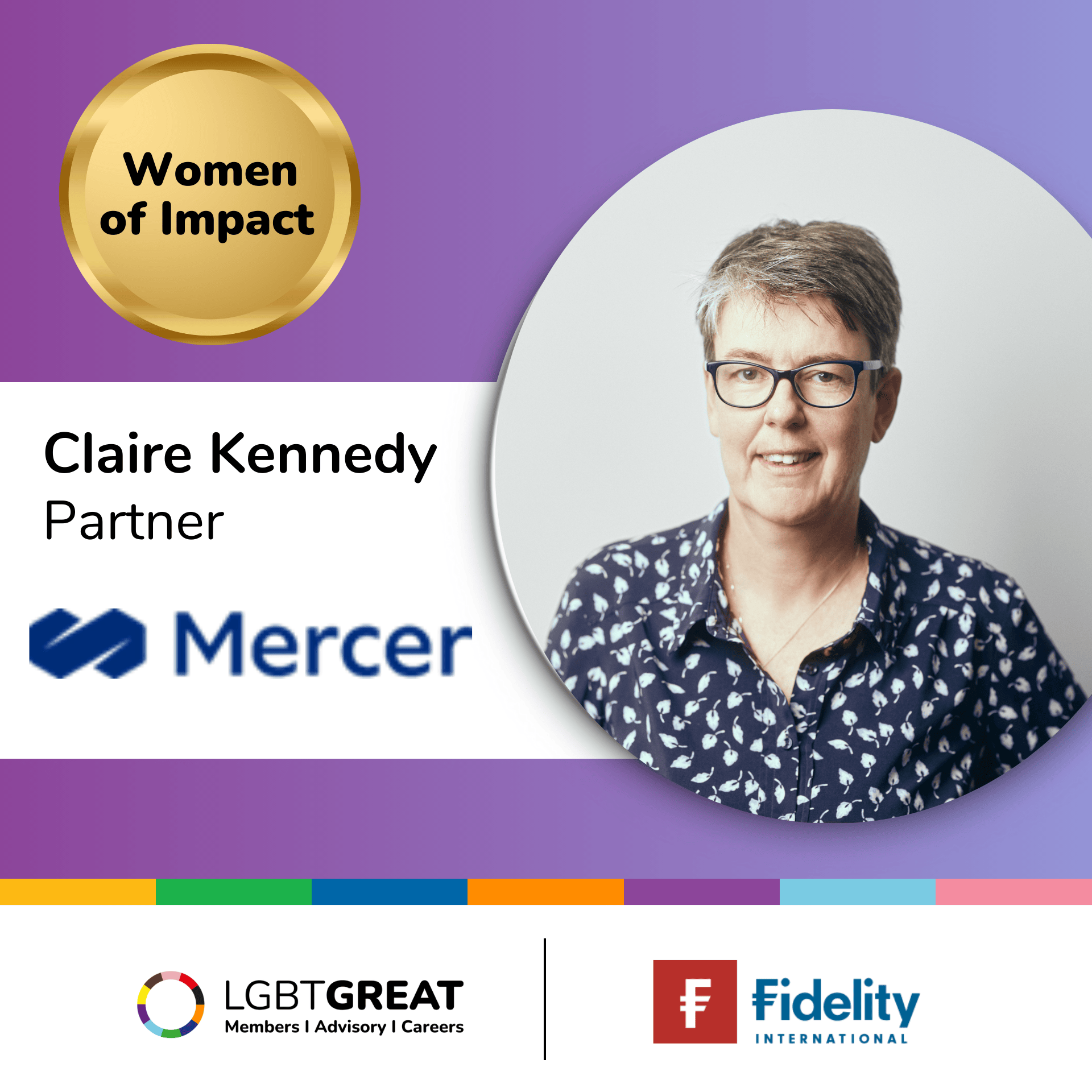
For this issue, I spoke to Claire Skinner Kennedy, Partner at Mercer, with over 20 years of experience within the pensions and investment industry. Alongside her role in Mercer’s UK Client Team, Claire has been heavily involved in various DEI initiatives and resource groups and was confirmed as Mercer IS International DEI lead in 2021. Driving inclusion in and beyond her organisation, Claire has been recognised for her commendable efforts and is a four-time winner of the Professional Pensions LGBTQ+ Trailblazer award. Talking role models, recruiting more senior women and listening to lived experiences, Claire unpacked the means by which leaders can establish workplace cultures where everyone feels able to bring their authentic self to work.
As has become a common thread throughout the Women of Impact editorial series, the impact of gender on the workplace experiences of LGBTQ+ women emerged as a key talking point in Claire’s interview. This was particularly pertinent when conversation turned to the key barriers to inclusion for LGBTQ+ women in the workplace, as Claire reflected on how the experiences of LGBTQ+ women are compounded by the overall gender imbalance of workforces within financial services. With fewer women in the industry, Claire explained how LGBTQ+ women may feel held back by both their gender and sexuality.
Well, I think I mean in finance, I think you know you are still in a minority being a woman. You know, whilst it has improved, often if I walk into a meeting I will be the only woman, or there'll be a woman taking the minutes – so yeah, you are definitely still in a minority. And so, bringing an LGBT [identity] on top of that creates another difference, I think. And I think that will, kind of hold people back.
Claire explained how this gender imbalance was at its most apparent when looking to senior leadership; despite recruiting on an almost 50/50 basis at more junior levels, Claire emphasised that organisations in the financial sector nevertheless struggle to recruit senior women.
Organisation tend to recruit kind of more or less 50/50. And you have more women leaving and organisations often struggle to recruit senior women. And so, despite the best of intentions, it's not getting any better. People think it will get better because it'll work out over time because you recruited more women and it doesn't because women leave and you struggle to recruit senior women. And you know, part of women leaving is around, things like work life balance and maternity leave.
With an evident lack of women in senior roles, the number of visible LGBTQ+ women role models is inevitably impacted. Thinking about the ways in which organisations can tackle the systemic barriers that prevent LGBTQ+ women from achieving career growth, Claire offered some practical steps that could be taken to modify recruitment practices in order to recruit more women into senior roles and tackle the gender imbalance that currently exists across organisations in financial services.
And then recruiting senior women is again looking in different places, so not necessarily saying I need somebody who has got experience in this exact job, because you're not going to get a woman or somebody different. But maybe saying, oh, you know, somebody who is a returner, who's had some time out, for example, but also maybe sort of slightly tangential experience that you might be able to bring something different again. So yeah, just try to try and think differently about the whole recruitment process.
Against the backdrop of a lack of women in positions of seniority, Claire spoke of the importance of LGBTQ+ women role models in the workplace, yet recognised that they are often few and far between. Speaking to her own experience, Claire explained how she made a conscious decision to be out at work when returning to Mercer in a more senior position following a short stint in different career, aiming to raise the visibility and challenge the lack of representation of LGBTQ+ women in financial services.
So, when I came back to Mercer in an environment where I had a much more senior position and I understood the support from colleagues and HR. I thought right actually I need to be more of a role model in that environment because that's something that I can do.
Whilst Claire noted the integral role that role models often play in encouraging others to bring their authentic selves to work, she also emphasised that they cannot alone change the culture of an organisation or fully provide the psychological safety that it often takes for individuals to feel comfortable enough to come out at work. Indeed, for Claire, inclusive workplace policies, training and educational opportunities are essential in establishing a culture where individuals feel happy and able to bring their ‘whole selves to work’.
But I guess that [having visible role models] needs to be coupled with allies and training and policies. So that people [know] what a microaggression looks like; they know, like, why you shouldn't ask somebody how they got pregnant or how does getting married [as an LGBTQ+ woman] work? Why maybe it's not appropriate to ask those sorts of questions, [and] how to deal with those circumstances if you see them…And that if something does go wrong, that there are very clear procedures that you are confident in using and that actions will be taken and that people see those circumstances when that has been the case. So, I think, yeah, I think role models are really crucial. But I think you know that's the kind of tip of the iceberg and you need to have all of this other stuff underneath it to support it. Otherwise, you've got, you know, one person at the top there who is trying to do it all.
As emphasised here by Claire, clear workplace policies, training and educational opportunities and allyship are key components in creating authentically inclusive organisations. When I asked Claire what advice she’d give senior leaders to help close the gap in representation for LGBTQ+ women in the workplace, she explained that listening to lived experiences and fostering open communication is key. For Claire, being honest, sharing personal stories, and actively trying to foster understanding are key steps that senior leaders can take in the journey towards inclusion and building workplaces where LGBTQ+ women are better represented and more visible. This is particularly pertinent, she explained, when confronting and dealing with negative incidents, microaggressions or experiences of discrimination at work.
I often get, you know people say to me, ‘oh, but we're, but we're really good, we're really good with all this stuff [LGBTQ+ inclusion]’ and [they] just can't get their heads around why somebody might not want to be out or you know, that something might have happened because they've never seen it. So, I think being really honest about sharing some of those stories and those circumstances and then like I say, making sure that you have the process in place. But also, you know like giving examples of when that has happened.
I think some organisations really struggle with that because they don't want to say, ‘Oh yeah, somebody said the wrong thing’, but I think that's what you need to do. You need to confront it and learn from it and have an open environment where people can discuss it.
For Claire, greater transparency and openness is an important step in, not only addressing and highlighting workplace microaggressions or prejudicial behaviour and discrimination, but also in providing vital opportunities for education and conversation amongst colleagues and peers. In operating from a place of honesty and openness by being upfront about negative incidents, greater understanding is promoted and inclusive places of work are created. This is an essential task that the Women of Impact programme has set out to achieve; underlining the barriers to inclusion and highlighting examples of discrimination that LGBTQ+ women face at work is essential on the journey to eradicating them. We after all cannot seek to challenge sexism, misogyny, homophobia and transphobia if we do not first address that they exist and impact the experiences of LGBTQ+ women in the workplace.