
Perspectives: Bi Visibility Day - In Conversation with Kirsten Whitworth
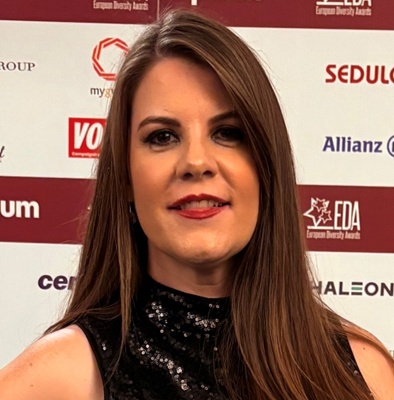
Our interview with Kirsten Whitworth (she/her), Senior Legal Counsel, Sky and Dr Beth Charlton (she/her) Consultant - Research, Workplaces and Data, LGBT Great
Since 1999, the 23rd of September has marked Bi Visibility Day; founded to challenge bisexual and biromantic erasure, the day has grown from a one-off celebration in the US to being officially marked by over 30 countries worldwide. With bi-erasure and biphobia continuing to impact the lives of many in the LGBTQ+ community, Bi Visibility Day offers an opportunity to reflect on the distinct experiences of invisibility, stereotyping and discrimination that many bi people continue to face, whilst amplifying bisexual voices, raising awareness and challenging assumptions and promoting understanding and education.
To celebrate Bi Visibility Day 2026, we spoke to the inspiring Kirsten Whitworth, Senior Legal Counsel in the Consumer Regulatory team at Sky. As a member of the Sky Legal Diversity and Inclusion Committee, Kirsten has headed up the Sky Legal LGBTQ+ Working Group for over four years. Since February 2025, she has been co-Chair of LGBTQ+ at Sky, Sky’s LGBTQ+ employee network, where she has spearheaded initiatives around LGBTQ+ rights and inclusion, including leading the network’s first participation in London Trans+ Pride and advocating for appropriate responses to the UK Supreme Court’s ruling on trans rights.
With a background in human rights law, Kirsten is a powerful voice for inclusion and visibility, and a passionate advocate for a society based on the values of human dignity, equality, and freedom. During our passionate – and at times emotional – conversation, Kirsten spoke of those that have inspired her, her commitment to being ‘aggressively out’, the impact that inclusive leadership can have and the importance of remaining vigilant in the face of adversity.
Contending with biphobia and becoming a role model
Thinking back on her career in both Johannesburg and London and across various industries, Kirsten pointed to the difficulty in identifying specific instances of discrimination that she’s faced due to her sexuality in the workplace; instead, she pointed to more subtle examples such as the attitudes of her colleagues and their unconsciously held assumptions that have impacted her experiences at work. She explained that:
People have felt quite comfortable asking questions about my sex life, for example, in a way that I don't think they do for people in other groups. And I think that's because there's the assumption of [bisexual people are seen as] being greedy or indecisive, or you just haven't met a real man, and so that has been tricky sometimes.
Kirsten is not alone in facing questions from or conversations with her colleagues that are rooted in biphobic stereotypes. Indeed, as scholars Caroline Vonlanthen and Annie Roy-Charland demonstrate in their systematic literature review of biphobia, associating bisexuality with confusion, indecisiveness, instability and promiscuity are common ways in which biphobia manifests. Recent research has underscored how the recurrent sexualisation and objectification of bisexual women – such as that outlined by Kirsten above – can cause feelings of hurt, disempowerment and anger, and ultimately contributes to the invalidation and erasure of bisexual identities. Contending with such biphobic assumptions and microaggressions ultimately contributes to bisexual employees being three times less likely to come out at work compared to their lesbian and gay siblings.
Our recent study on the experiences of LGTBQ+ women in the workplace spoke to the sustained insufficient representation of LGBTQ+ women at work, whilst underscoring how crucial visibility can be, with visible role models helping to foster psychological safety, allowing other LGBTQ+ women to feel seen, represented and advocated for. Characterising herself as ‘aggressively out’, Kirsten similarly emphasised the gravity of visibility, explaining why she feels it’s so important that she’s out and talks openly about her sexuality at work.
I grew up in apartheid South Africa where all of our freedoms were fought for by people who literally died for us. So if someone's going to get shirty with me because I reveal my sexuality, that's really not a big sacrifice. And I'm quite fortunate that, through legal training, upbringing and education, I'm pretty articulate and confident and ready for a fight, so...I take it upon myself to be out so that if I'm the first person in a group or in a company or in a team, whatever, who’s out, they'll have dealt with that should someone else come behind me who may not have such an easy time of it and be less willing to be out or more worried about what it means. I’ve taken on a personal responsibility to pave the way.
In seeking to make spaces safer and more inclusive for those who come after her, Kirsten embodies one of the top three behaviours of what 1 in 5 of the LGBTQ+ respondents to our Seeing is Believing research considered to be a marker of effective role modelling. Recalling an interaction with a junior colleague on secondment in her department, Kirsten points to the significant impact that unapologetically out role models can have on others.
We had someone on a secondment in Sky Legal, just starting out in her career. And I made some throwaway comment in a presentation at a town hall to the whole legal department about being bi. She came to me afterwards and said, oh my God, I didn't know you were allowed to talk about these things at work. And she didn't mean at Sky; she meant in her career. She said ‘I've been so scared to say anything’. And it was just the fact that she can now go into her career and at least she's seen an example. Now obviously not all workplaces are the same, but she has seen someone do it and be comfortable with it. And seen the people around me be comfortable with it. That's huge.
As Kirsten described the impact that her decision to be ‘aggressively out’ has had on those around her, I wondered if she had anyone at work who had paved the way for her. [TRIGGGER WARNING: The following passage references sexual violence]
For me personally, no. But I come from a country of struggle heroes that I admire. I'm going to cry when I talk about it. And it's not just, it's not just being South African, it's what happened at Stonewall. It's the trans women who stood up for us all. And it's the people who've been willing to risk imprisonment or execution by just standing up for what's right. And... I know everyone obviously will see the world differently, but I've had a relatively easy ride of it. I've had some mean comments and, I've been uncomfortable in corporate situations, but I've generally had a pretty easy go. In South Africa, there’s a particular type of sexual assault so well established that it has a name: corrective rape. It appears to stem from the idea that ‘we can cure these women of being gay by raping them’. And I haven't had anything close to that. And given I've had such an easy ride it would not be appropriate for me to be quiet; I owe too much to the people who actually struggled every day. It's too great a debt to then not try to help others.
Leadership for Inclusion
Turning our attention to Bi Visibility Day and the current challenges facing the LGBTQ+ community, I asked Kirsten what she felt were the biggest barriers to inclusion for bi people in (and beyond) the workplace.
I think for bi people, it's the bi erasure that we see – either not gay enough or not straight enough – and people dismissing it as not a proper sexuality. But I tend to think that...given the transphobia that is just rampant, we have much bigger problems. And that's not to do down any bi people who are feeling the struggle, but we have people being legislated out of existence. It's very difficult to see how anyone how any government, organization, group can claim to be inclusive when they choose to exclude people for an arbitrary physical characteristic. And exclusion of trans people is on the basis of an arbitrary physical characteristic… These people aren't going to stop just when they deal with our trans community. That’s not where it's going to stop. It's the thin edge of the wedge. And so women's reproductive rights are likely going to be next. Gender, sexuality, it's all up for [grabs] and these freedoms have been so hard fought for, so hard won.
Whilst in no way diminishing the biphobia that many face day-to-day, Kirsten pointed to transphobia as one of the most pressing challenges that the LGBTQ+ community face today, warning the community about complacency and the risks that go with it. The legitimisation of exclusion using institutional structures against any LGBTQ+ identity is precedent for concern for the wider community; it is paramount that in times like these, when rights and protections are being threatened that we come together and continue to strive for workplaces, organisations and societies that are inclusive and safe for all.
In times such as these, when uncertainty and fear are experienced by many, it’s more important than ever that senior leaders work to create environments where everyone feels safe, supported and respected. LGBTQ+ visibility, role models and awareness building can only go so far in shifting the culture of a workplace or organisation; after all, as we have established, leaders ultimately set the tone, helping to build a culture of belonging from the top down. With this in mind, I asked Kirsten what advice she would give senior leaders to help cultivate authentically inclusive workplaces.
Overwhelmingly my main tip is to just be present… just show up. It's all very well saying ‘as an organisation, we are very inclusive’. But if none of your senior management team come to events put on by ERGs, or participate in things, it's very difficult to see how inclusive that organization actually intends to be.
For Kirsten, the presence and participation of senior leaders at ERG events not only signals organisational inclusion, but it also gives permission and encourages others to take time out of their workday to get involved. She explained further:
I think what senior leaders in large organisations don't realize is how little autonomy people actually have over their own time during the work day. And so it may be that you've got exec sponsors or leaders or CEOs or whoever saying that great things are happening; we love seeing people get involved. But if they don't go and they don't sacrifice the time, they are signalling that no one else can, that time is too valuable to give to those issues. And the reason it's my advice is that it's a very easy win. It's very easy to find that half an hour. Or if there's an online event that senior leaders can join and have their cameras on and be visibly present and engaged.
Bi Visibility Week & Reflections
Towards the end of our conversation, I asked Kirsten to think back on her career whilst reflecting on the present context we find ourselves in, and the role that awareness days like bi visibility day can play in helping change the conversation. Whilst Kirsten noted that celebration days such as these aren’t necessarily successful in increasing LGBTQ+ acceptance in the workplace, she explained their value in promoting education and understanding.
I think they're very good for awareness. One of the things we did for asexuality day, ace and aromantic, was to just explain what it was. And we had a colleague who wrote a few lines about it from her perspective. And because she was prepared to be visible for that, that was really effective. I think it was effective both to have her story, but also for people who’d always wondered what it is…I think they’re great for awareness, I think that's the win. Because it's the barriers to understanding that we need to break down.
As organisations continue to raise awareness of LGBTQ+ identities, lives and lived experiences through marking and celebrating awareness dates like Bi Visibility Day, greater visibility of LGBTQ+ people will no doubt follow. With this in mind, Kirsten’s advice to younger LGBTQ+ folk who are entering the workforce and beginning their careers is very much informed from her own experience of paving the way and striving for progress, urging those who are able and safe to do so to bring their whole selves to work as ‘the more people who are themselves and bring themselves to work, the more it creates space for others to do it. And I think it’s worth giving it a shot’. Considering the socio-political environment we find ourselves in, and the risks complacency brings, Kirsten leaves us with some very welcome wisdom.
I think for anyone who's looking at issues or wanting to change things or wanting to organise, the advice would be don't let a desire for perfection get in your way of doing something. It's okay to do something and say, we tried it this way and it didn't work out, or it had different consequences, or we could have done it better. But sometimes you just need to get things done and you need to make a start. Progress is important – it doesn't have to be perfect.
As Kirsten reminds us, progress is not always perfect, nor is it always linear or immediate; the important thing is continuing to show up and take action no matter how small. For those in the workplace seeking to make meaningful change this Bi Visibility Day, this means looking beyond recognition and toward sustaining genuine inclusion throughout the year.
Our ERG Toolkit's Connect, Inform, Transform framework provides a practical pathway for doing just that: creating spaces where people can connect through shared experiences, inform one another through storytelling and education, and ultimately transform cultures, policies, and practices. When these steps are taken consistently, incremental change can become meaningful and lasting progress. For more information and access to our member-only toolkit, email us on: info@lgbtgreat.com