
Perspectives: Lesbian Visibility Week - In Conversation with George Hayes
Authored by Dr Beth Charlton
In the summer of 2024, amidst a period of heightened lesbian representation in mainstream popular culture and across social media platforms, it was declared that the ‘Lesbian Renaissance’ had arrived. With the increased popularity and mainstream success of openly lesbian musicians, the release of films and TV shows centring on explicitly lesbian characters and narratives, alongside a proliferation of new FLINTA (Female, Lesbian, Intersex, Non-Binary, Transgender and Agender) spaces and events for sapphic folk popping up in many cities, the so-called Lesbian Renaissance has been credited by many as being a huge win for lesbian visibility. Whilst certainly offering positives for our community – not least in providing younger folks or those exploring their identity with the role models and representation that many of us didn’t have – the real-life impact that this cultural moment has had on inclusion and meaningful change for the lesbian community is up for debate.
Indeed, in tandem with this newfound representation, we have also witnessed sustained attacks on LGBTQ+ rights and protections across the globe as political tides have turned. In the UK we have seen an increase in homophobic and transphobic hate crime over the past five years, the persistence of unequal access to health- and fertility-care, and consecutive governments promising – yet failing – to prohibit conversion therapy under law. Even visibility in the media is waning, as the BBC announced last month that the hit TV show I Kissed a Girl would not be renewed after it’s second season despite huge success.
Whilst representation is undeniably important, material and meaningful change that betters the community is paramount. That’s where Lesbian Visibility Week (LVW) comes in; founded in 2020 by publisher and CEO of Diva Magazine, Linda Riley, LVW has been taking place each April to celebrate recognise and uplift lesbian communities across the globe. Since its inception, LVW has played an important role in bringing vital public attention to the experiences, perspectives and needs of LGBTQIA+ women and non-binary people. Alongside raising the visibility of those who are too often overlooked, crucially LVW exists to build understanding and ‘create a legacy that benefits our community everywhere’.
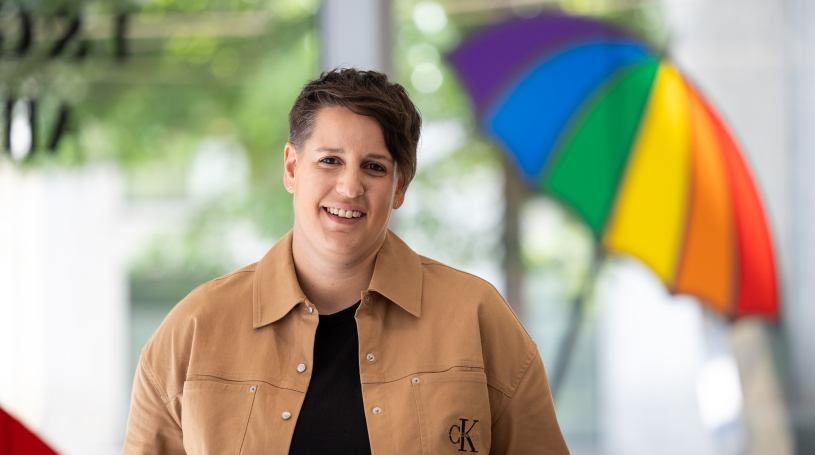
To celebrate this year’s Lesbian Visibility Week, we’re delighted to spotlight our conversation with the brilliant George Hayes. George – a Conduct Risk and Compliance Consultant and co-chair of the Pride Network at Legal & General – is a self-proclaimed visible and vocal lesbian in the workplace, passionate about cultivating safe environments for LGBTQ+ people at work. Emphasising why she strives to be the most authentic version of herself, George talked all things lesbian visibility, the importance of role models and why continuing to spotlight lived experience and encourage conversation is crucial.
Being Visible & Vocal
When considering the beginnings of her career, and what the environment was like at the time for LGBTQ+ people, George pointed to the openness she has embodied since she was young, explaining how her vocality and consequent visibility that has characterised her experience at work was a continuation from her days at school.
I've always been quite a vocal out lesbian in the workplace, not really through choice, more just that's kind of how I've lived my life. I was the first person that knowingly came out at school. I went to an all-girls school in a conservative part of the country. It was very non-LGBTQ+ friendly. When I was at school, it was still kind of operating under Section 28. We had no out teachers, and no inclusive sex education, so, against that backdrop, I decided I was bored of hiding who I was. So, I came out at school. I was quite young. I think I was 14…I was in year nine, and I started an LGBT group. And then ever since then, I've just kind of just always been visible.
George’s commitment to being her authentic self that arose in her teenage years, has seen her go on to navigate her career with an admirable willingness to be visible. When joining L&G almost 16 years ago, George was quick off the mark to come out to her colleagues, spurred on by a not entirely inclusive icebreaker exercise, she made the decision to be open about her sexuality and has not looked back. She acknowledged, however, that whilst for her, being out and vocal in the workplace came naturally, for others, being visible continues to be challenging.
We have a distinct lack of out lesbians in the workplace. I don't think that's uncommon. I don't think it's an L&G thing. I think it's just, there are a lack of visible lesbian role models. We also still have gender disparity in workplaces at a senior level, so, I was like, well, if anyone's going to do it, I may as well do it and I'll bring some people along for the ride. But even now, there's not many individuals that would happily stand up and say I'm an out and proud lesbian. Even though statistically we must have lesbians in our workplaces, I just think there's still this barrier between being feeling safe to be who we are, and being deliberately visible.
Here George points to the continuation of lacking lesbian visibility that she has witnessed throughout her career. George is not alone in making this observation; as our Women of Impact research highlighted, despite improvements in workplace protections for the LGBTQ+ community and increased opportunity for building connections and support networks through ERGs and pride networks, the visibility of LGBTQ+ women nevertheless remains low. For a number of participants, the dual impact of misogyny and homophobia – compounded by the absence of visible role models – was one of the key barriers impacting their willingness to come out at work. Ruminating on the impact that the lacking representation of LGBTQ+ women in her own organisation has had on her, George explains how the lack of visible role models has further motivated her to take on this role.
Sometimes you feel like there's a pressure on you to be the spokesperson for a group of people. And actually, I don't really like talking on other people's behalf. Personally, I'd much rather advocate for others, create space for them, and give people a platform to share their authentic stories and be able to be themselves. But if simply me being this [visible] in the workplace means that it gives people the confidence to feel that they belong, even if they don't want to talk about it openly, and as long as they feel safe, then that's what's important to me.
Advocating for Change through Education, Awareness and Understanding
Motivated to improve the experiences of others at work, George has been dedicated to supporting the LGBTQ+ community at L&G, helping to cultivate safe environments for people to be themselves. She emphasises that ‘So I want workplaces to feel like whoever you are, whatever you bring, this is a place where you can thrive and be accepted for who you are. So that's kind of why I do what I do’. As her experience of establishing an LGBT club at school aged 14 may have perhaps foreshadowed, George is now co-chair of L&G’s LGBTQ+ network – the responsibility and importance of which is certainly not lost on her.
But I think growing up queer, most people have some level of insecurity, whether that’s a lack of confidence, bullying, trauma, or homophobia or transphobia that they carry with them. People bring that kind of stuff with them into the world of work, even if their working environment is different to school or university and I don't think it's any better now for young queer people than it was for me. In fact, social media, I think, probably makes it worse and people become keyboard warriors and become a bit anonymous. At least I knew what people thought about me and I could advocate for myself and others in the moment. But I think what companies don't realise is what people bring with them into the workplace. So, when they start a new company, even if the company is inclusive, and even if you are confident and able to be out and visible and there's a good queer support network around you, I think people don't recognise how difficult it can be for people to perform at their best.
For George, educating others on the lived experiences of LGBTQ+ people – both in and out of the workplace – is therefore an essential step in building inclusive environments. Indeed, this was reiterated in our Women of Impact research, which underscored that one of the key methods to enable change for LGBTQ+ women at work is through listening to lived experience and being honest and transparent about the challenges that exist for LGBTQ+ women in the workplace. Considering her own challenges that she has faced during her career – particularly with regard to the dual impact of sexism and misogyny – George explains that whilst prejudice certainly still exists, she believes it largely stems from a lack of understanding.
There's always going to be someone that thinks that your gender identity or your sexuality makes you different and not capable. But broadly, I think it comes from a lack of understanding. I think people just don't know what it's like to be in those positions.
With a lack of understanding driving exclusion, George explained that making space for conversation and connection, in order to promote education and learning, is thus vital.
I think people learn best from lived experience; sit down with a trans person, sit down with a non-binary person, sit down with a lesbian, a gay man, whoever, just sit down with somebody, have a conversation about what it's like to walk in their shoes, have a conversation about their life. And most importantly, ask how you can show up for them.
George acknowledged that this is sometimes easier said than done, however, as leading with lived experience can sometimes place the burden of educating others back onto members of the LGBTQ+ community.
It's really hard to do that without asking people to be in the spotlight. And I think that's some of the barriers we face; how do we ask people to share their lived experiences without making people vulnerable, or conversely, as I was saying earlier, being the only people in the spotlight. I don't want to speak for every lesbian in L&G. We also have some very confident trans and non-binary people in the workplace, but it's not fair to ask them to always be the voice of the trans community or the non-binary community. I think we just need to normalise differences. I think that that would help so many more people. But it's how you unlock that and how you hold space for those conversations that is important. People need to feel safe to be who they are.
For George, Lesbian Visibility Week – along with other awareness days – is an important means of providing a platform to stage such conversations around, creating educational opportunities and providing marginalised communities with much needed visibility, without having to rely directly on colleagues sharing their own personal journeys.
I think it's important that we mark and celebrate any notable date in the diary. Personally, I love Lesbian Visibility Week because it means everyone messages me once a year to say ‘thanks for being a great lesbian’. But to be less tongue in cheek, I think it's really important to have weeks [like LVW]… I think anything that brings attention and draws a spotlight onto a marginalised group of people, that is always going to be a good thing. I think it helps drive education, and it also helps people realise that there are other people like them. So, from a visibility perspective, I think it's really important to mark notable dates because suddenly it's like, oh, inclusion isn’t just for Pride month. And it runs so much deeper than just LGBTQ inclusion - we should put just as much effort into celebrating Lesbian Visibility week, or Black History Month, or South Asian Heritage Month, or International Women’s Day or Neurodiversity Celebration Week, the list goes on. I think it just brings people together. It helps drive those conversations, gives people a platform and a spotlight. And it also means that you can use those opportunities to talk about marginalised groups, or individuals that you wouldn't necessarily be able to hear from at any other point in the year. So yes, I think they're really important.
As George highlights here, whilst visibility is the first step in the journey toward creating inclusive workplaces where lesbians and other LGBTQ+ women can thrive, opportunities must be grasped to turn representation into concrete change. By using Lesbian Visibility Week as an engine to drive conversation, promote education and build awareness, we can contribute to LVW’s project of building a legacy that benefits our community everywhere. To find out more about how lesbians experience the workplace day-to-day, the challenges and barriers to inclusion they continue to face, and the actions you can take to help improve the experiences of LGBTQ+ women in your organisation, you can download our new research – Raising the Bar: The Experiences of LGBTQ+ Women in the Workplace – here.